The Sennheiser VSM 201 is a late-1970s analogue vocoder with 20 frequency channels. Its history connects speech research with electronic music, but its value as a sound-design reference is practical: it encourages you to think separately about the voice, the carrier and the way each frequency band responds.
Where the VSM 201 fits in vocoder history
The vocoder did not begin as a robot-voice effect. Early work associated with Homer Dudley in the 1930s investigated transmitting speech through a reduced description of its sound. Military communications later became another important application.
A historical study by Rüdiger Hoffmann and Sennheiser archivist Gritta Gramm traces the company's work from communications research to musical use. It records the VSM 201's presentation at the 1977 Audio Engineering Society conventions in Paris and New York. Its 20 channels covered approximately 100 Hz to 8 kHz, and it remained in Sennheiser catalogues until 1981. Composer Heinz Funk helped demonstrate, distribute and use it.
Sennheiser's retrospective with Hainbach places the instrument in the worlds of Kraftwerk and Jean-Michel Jarre and describes an exceptionally small production run. That rarity is part of its reputation, but buying a rare machine is not a prerequisite for learning from the underlying technique.
What a filter-bank vocoder actually does
A musical vocoder takes a changing signal, usually the voice, and uses its spectral shape to control another sound. The voice is the modulator; the synthesizer or other material being shaped is the carrier. In a channel vocoder, analysis bands follow different frequency regions and control corresponding regions of the carrier.
This explains a common surprise: singing into a microphone is not enough if the carrier is silent. It also explains why changing the carrier can alter the result dramatically even when the same vocal recording is used.
My VSM 201-inspired VST
I first built effect chains in Ableton and Reaper to emulate the Sennheiser VSM 201 vocoder. The chains became too cumbersome, so I created a dedicated VST modelled on the VSM 201. The Reaper chains were an early experiment, not the finished instrument.
The VSM 201 is the historical reference for the VST, but the instrument should be described as modelled on or inspired by it, not as an exact circuit or sound reproduction.
A listening exercise: change the carrier before the mix
- Record one short, clearly spoken phrase and keep the recording unchanged.
- Feed a sustained sawtooth-based sound into your vocoder. Begin in a middle register.
- Repeat with a darker carrier, then a brighter one. Match output levels as closely as practical.
- Compare a single note with a simple chord. Listen for intelligibility, weight and the amount of space the result occupies.
- Only then add ambience and evaluate the phrase with the rest of the track.
This is an exploratory exercise for a modern vocoder, not a VSM 201 preset. Write down what improved the words and what improved the mood; they may be different choices. A short hook might benefit from precision, while a background texture can tolerate ambiguity.
Does a higher band count always sound better?
No. Band count alone cannot describe the complete result. Filter shapes, timing, frequency coverage, source material and musical context all matter. Choose the sound for the phrase you want to communicate, rather than treating one specification as a quality score.
For another approach to electronic speech, read about the DigiTech Talker. For a physically different method, see the talkbox guide. You can also explore my music and videos.
Sources
- Hoffmann and Gramm: The Sennheiser Vocoder Goes Digital, HSCR 2017, including the VSM 201 section.
- Sennheiser: VSM 201 retrospective with Hainbach.
Cover image
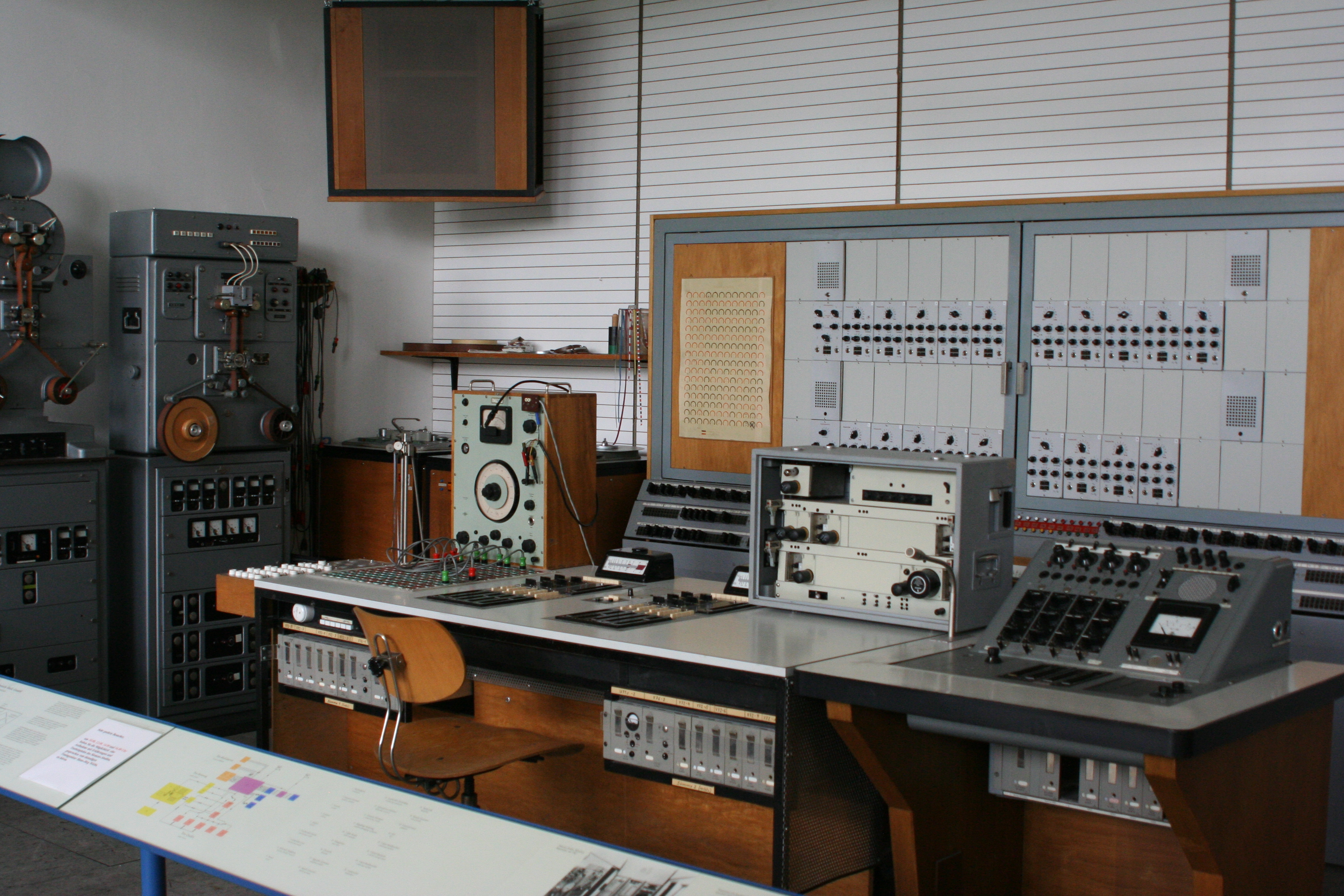
Historical context: the Siemens electronic music studio at the Deutsches Museum. The image does not show a Sennheiser VSM 201. DM Recording Studio — Ben Franske, via Wikimedia Commons. CC BY-SA 2.5. Image unmodified. Shows Siemens Studio at Deutsches Museum, not a VSM 201. License: CC BY-SA 2.5.
